
An Orange County fireworks injury claim can involve more than a painful burn. Fireworks can cause eye trauma, facial injuries, hand injuries, hearing damage, scars, fractures, fires, smoke inhalation, and wrongful death. A celebration can turn into a serious legal case within seconds.
This topic matters in 2026 because fireworks safety is again in the spotlight before July 4. The U.S. Consumer Product Safety Commission reported 11 fireworks-related deaths in 2024. It also estimated 14,700 fireworks injuries that year. Burns made up the largest share of emergency room visits. Hands, fingers, the head, the face, and the ears were also common injury areas.
Orange County doctors have also warned families about fireworks danger. UCI Health notes that fireworks can cause limb loss or death. Its Regional Burn Center treated fireworks-related injuries in 2025, including cases involving eye and facial damage. The warning is clear. Fireworks that look small can still cause severe harm.
For victims, the legal question is not only whether a firework exploded. The bigger issue is who created the danger. A claim may involve a homeowner, party host, property owner, product seller, event organizer, manufacturer, or person who lit the firework. It may also involve illegal fireworks, unsafe crowd placement, poor supervision, or defective products.
Why Orange County Fireworks Injury Claims Are Trending in 2026
Fireworks risks rise during summer events, neighborhood gatherings, holiday parties, and July 4 celebrations. Some cities allow limited “Safe and Sane” fireworks under strict rules. Other cities ban fireworks completely. Even where certain fireworks are legal, altered fireworks and aerial fireworks may still be illegal.
Local rules can matter in an Orange County fireworks injury claim. The City of Orange explains that Measure AA allowed Safe and Sane fireworks under city rules, but not all fireworks became legal. The city says altered Safe and Sane fireworks and fireworks of any other kind remain illegal there. It also limits when and where approved fireworks can be used.
California fire safety guidance also warns residents to check local laws before using fireworks. CAL FIRE explains that illegal fireworks include sky rockets, bottle rockets, Roman candles, aerial shells, firecrackers, and other fireworks that explode, fly, or move in an uncontrolled way. That guidance also says parents may be liable for damage or injuries caused by their children using fireworks.
Those rules matter because insurance companies and defense lawyers often look at legality. If someone used illegal fireworks, ignored local restrictions, or handled fireworks near children, homes, crowds, dry grass, or flammable materials, the victim may have stronger evidence of negligence.
Illegal fireworks can create stronger liability evidence

Illegal fireworks can change the case. A person who uses prohibited explosives may face more than a safety warning. That conduct can support an argument that the person acted carelessly or recklessly. If the illegal firework injures a guest, neighbor, child, pedestrian, or bystander, the user may face civil liability.
Orange County has already seen serious concern about illegal fireworks. Voice of OC reported in April 2026 that more local cities were tightening fireworks bans before July 4. The report discussed local ordinances that can make property owners liable when illegal fireworks are used on their property. That trend matters for injury victims because liability may extend beyond the person holding the lighter.
A homeowner or host may be responsible if they allowed illegal fireworks at a party. A property owner may face questions if they knew fireworks were being used and failed to stop the activity. Parents may also face scrutiny if a minor handled fireworks and injured someone.
Property owners and party hosts may share responsibility
A fireworks injury often happens at a private home, driveway, street, apartment complex, parking lot, or neighborhood gathering. In those cases, investigators should ask who controlled the property and who controlled the activity.
A host may have invited guests, supplied fireworks, allowed drinking, placed people too close to the launch area, or failed to move children away. A property owner may have allowed illegal fireworks on the property. A tenant may have created the danger in a shared space. Each fact can matter.
This is similar to other premises liability issues. A property owner does not become responsible for every accident. However, liability may arise when the owner knew or should have known about a dangerous activity and failed to act reasonably. For more related guidance, readers can visit the site’s Orange County slip and fall accident resources.
Children face serious fireworks risks
Children are especially vulnerable around fireworks. They may not understand that sparklers, smoke devices, or unexploded fireworks can still cause severe injuries. They may also pick up debris after a firework fails to ignite. That is one of the most dangerous moments.
UCI Health warns that fireworks that look like duds can remain live, unstable, and dangerous. Children should not handle fireworks, including sparklers. Adults should also avoid relighting failed fireworks or picking up abandoned devices.
If a child gets injured, the claim may involve supervision. Who allowed the child near fireworks? Who lit the device? Were adults drinking? Were children standing too close? Did the host set a safe boundary? Did anyone warn children not to touch debris?
Defective fireworks and product liability may also matter
Not every fireworks injury comes from careless handling. Some cases involve a device that misfires, explodes too soon, fires sideways, lacks proper warnings, or fails in a dangerous way. When that happens, the case may involve product liability.
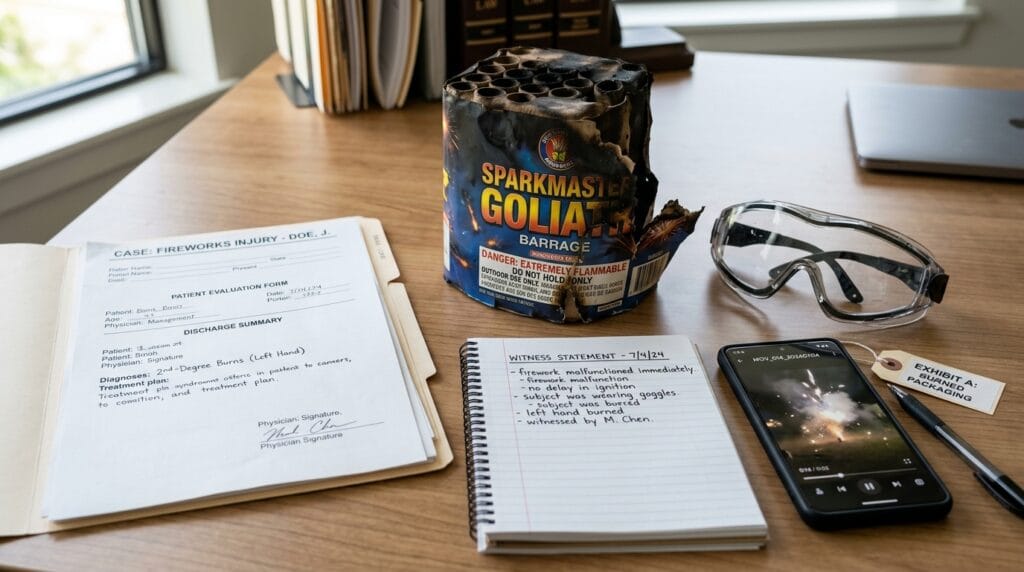
A defective product claim may involve the manufacturer, importer, distributor, seller, or other business in the chain of sale. The injured person may need to preserve the package, remains of the device, photos, videos, receipts, labels, and purchase records. Without those items, it may become harder to prove what product caused the injury.
Product cases can become technical. Experts may need to review how the device was designed, labeled, stored, sold, or used. If the firework was counterfeit, illegally imported, altered, or mislabeled, the case may become even more complicated.
Do not throw away the firework debris
Firework debris can become key evidence. Victims should not clean everything up too quickly if it is safe to preserve the scene. Take photos before anyone moves the remains. Photograph the launch area, packaging, labels, street, driveway, burns, scorch marks, damaged clothing, eye protection, nearby structures, and distance from bystanders.
Keep the product packaging if possible. Save receipts, online order records, text messages, party invitations, videos, and witness names. If a neighbor recorded the event, ask them to preserve the footage. Many people delete videos after a few days unless someone asks them to save the file.
This evidence can help show whether the device was illegal, defective, misused, or handled without reasonable care. It can also help identify all responsible parties.
Burns, eye injuries, and scars can increase damages
Fireworks injuries can require emergency care, surgery, skin grafts, eye treatment, physical therapy, occupational therapy, and long follow-up care. Some victims lose fingers. Others suffer facial scars or permanent vision problems. Even a smaller burn can leave painful nerve symptoms or visible marks.
Medical records are critical. Victims should explain exactly how the injury happened. They should also report pain, vision changes, ringing in the ears, breathing problems, anxiety, sleep issues, and emotional distress. Complete records help connect the injury to the incident.
Firework burns also connect well with the site’s existing fire injury content. Readers can review the article on lithium-ion battery fire injuries in Orange County because both topics involve burns, product evidence, fire investigation, and long-term medical damages.
How to Protect an Orange County Fireworks Injury Claim
After a fireworks injury, medical care comes first. Call 911 for burns, eye injuries, deep cuts, blast trauma, breathing problems, hearing loss, confusion, or severe pain. Do not treat a serious burn casually. Do not rub an injured eye. Do not delay care because the party host says the injury looks minor.
Report the incident. Police, fire officials, or emergency responders may create records that help prove what happened. If illegal fireworks were involved, that report may become important evidence. If the incident happened at a public event, business, school, apartment complex, or theme park area, ask for an incident report.
Victims should also document the full timeline. Write down who brought the fireworks, who lit them, where people stood, whether warnings were given, whether alcohol was involved, and whether children had access. Names, phone numbers, photos, and videos can matter later.
Insurance companies may dispute fault and damages
An Orange County fireworks injury claim may involve homeowners insurance, renters insurance, event insurance, commercial coverage, product liability coverage, or personal assets. Coverage can be difficult. Some policies may exclude intentional acts, illegal conduct, or certain explosives. Others may still provide coverage depending on the facts.
Insurance companies may argue the victim stood too close, ignored warnings, handled the device, or caused the injury. They may also claim the injury healed quickly. That is why evidence matters. Photos, medical records, witness statements, videos, and product packaging can push back against weak defenses.
Do not accept a fast settlement before the full injury is known. Burns and eye injuries can change over time. Scars may need revision. Vision problems may require specialist care. Hand injuries may affect work. A quick offer may not include future treatment, lost income, pain, emotional distress, or permanent damage.
For broader claim guidance, readers can visit the site’s step-by-step guide to filing a personal injury claim in Orange County. They can also review the Orange County Personal Injury Attorneys services page.
Fireworks injuries are preventable. A person should not have to pay the price because someone used illegal fireworks, ignored local rules, failed to supervise children, hosted an unsafe party, or sold a defective product. If you suffered a fireworks injury in Orange County, get medical care, preserve evidence, avoid rushed statements, and review your legal options before signing anything.