
Orange County roadside accident claims in 2026 involve an important change to California traffic law. Beginning January 1, 2026, Assembly Bill 390 expanded the state’s Move Over law to protect more people near stationary vehicles. The updated rule matters for drivers, passengers, tow truck operators, maintenance workers, and motorists waiting for roadside assistance.
California highways can become dangerous when vehicles stop unexpectedly. A disabled automobile along Interstate 5, State Route 55, or another busy Orange County roadway may leave its occupants exposed to passing traffic. An approaching driver who fails to notice warning lights or reduce speed can cause devastating injuries.
Previously, many drivers associated the Move Over requirement mainly with emergency vehicles and tow trucks. The expanded statute now addresses additional stationary vehicles displaying flashing hazard lights or warning devices.
However, an accident near a stopped vehicle does not automatically establish negligence. Investigators must examine the exact circumstances, including visibility, traffic conditions, driver behavior, and whether the law applied.
This guide explains the updated requirements, how roadside collisions occur, what evidence matters, and how California personal injury law may affect a claim.
How California’s Expanded Move Over Law Works in Orange County
California Vehicle Code Section 21809 requires drivers approaching certain stationary vehicles along a highway to exercise caution. When appropriate, they must change into an available lane that is not immediately adjacent to the stopped vehicle.
If changing lanes would be unsafe or impracticable, the driver must reduce speed to a reasonable and prudent level for existing conditions.
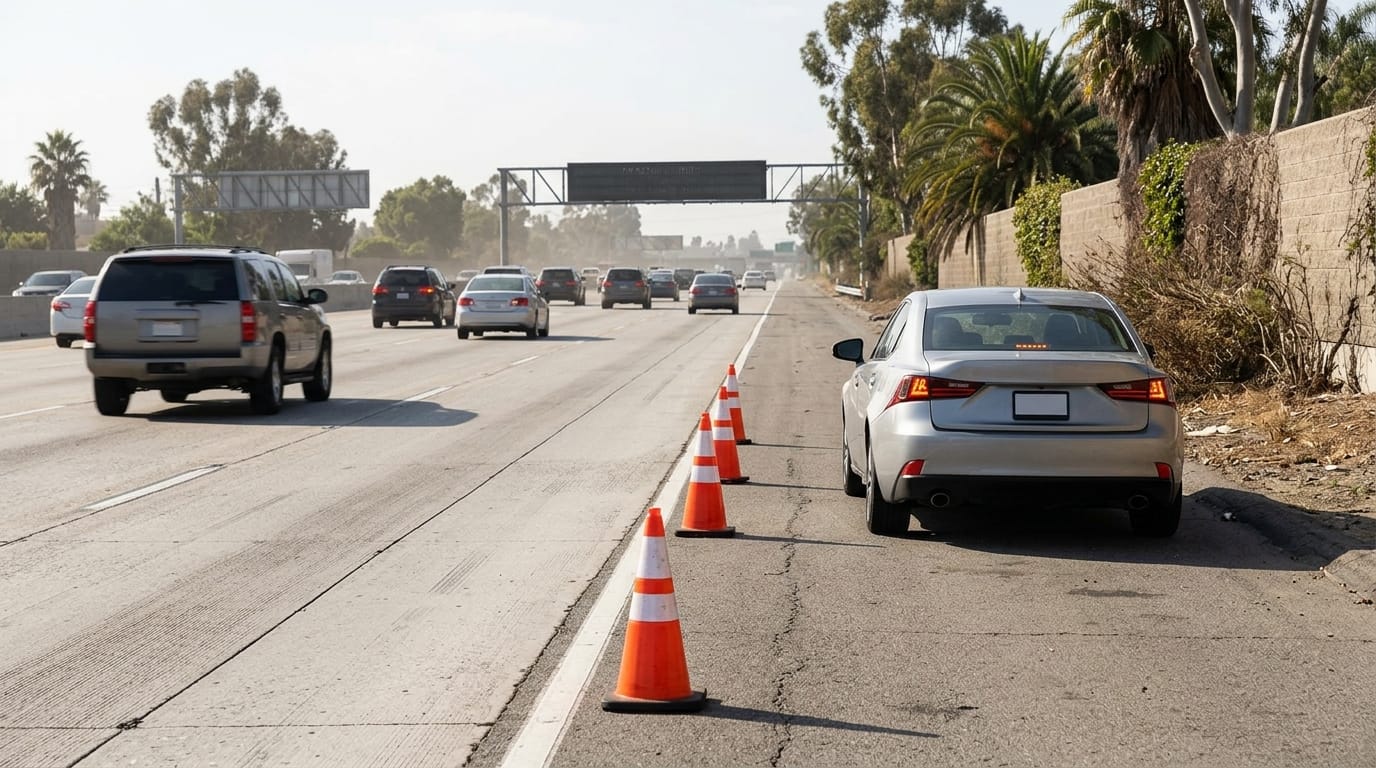
Assembly Bill 390 expanded the statute to include additional stationary vehicles using flashing hazard lights or warning devices, such as cones, flares, and retroreflective equipment.
The update recognizes that roadside danger is not limited to police officers or emergency responders. Ordinary motorists experiencing mechanical problems can also face serious exposure to passing vehicles.
The law contains exceptions, including circumstances involving qualifying vehicles separated from the highway by a protective physical barrier or not adjacent to the highway.
Which roadside vehicles receive protection under the updated law?
The statute covers qualifying emergency vehicles, tow trucks, highway maintenance vehicles, and other stationary vehicles displaying the specified warnings.
For example, a driver whose vehicle breaks down may activate hazard lights and wait for roadside assistance. Approaching motorists must consider whether they can safely move away from the adjacent lane.
A maintenance vehicle displaying warning lights may create a similar obligation. Cones or flares can also indicate that people are working or waiting near traffic.
Whether the law applies depends on the vehicle’s position, warning equipment, roadway configuration, and other statutory conditions.
Hazard lights, cones, and visibility can become important evidence
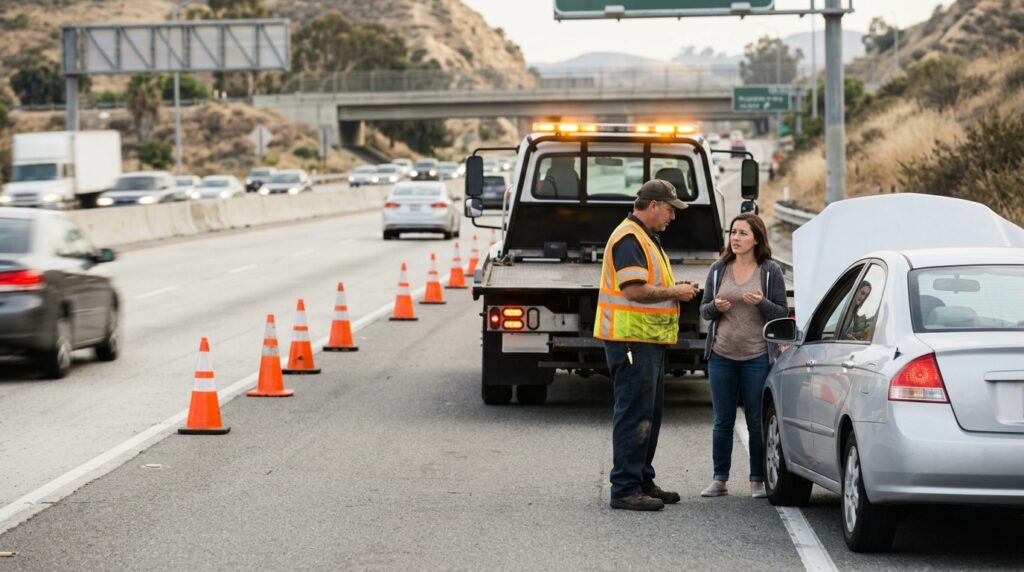
Warning devices help alert approaching drivers to unexpected hazards. When a collision occurs, investigators may examine whether the warning equipment was functioning and visible before impact.
Photos of activated lights, cone placement, nearby road signs, and available sightlines can help reconstruct the accident.
Visibility may also be affected by curves, darkness, weather, or large vehicles blocking the driver’s view.
Although warning devices can strengthen an investigation, their presence does not independently establish that the approaching driver violated the law.
Why drivers must slow down when changing lanes is unsafe
Heavy traffic sometimes makes changing lanes impracticable. A driver may have vehicles alongside them, limited space, or insufficient time to move without creating another hazard.
In those circumstances, California law requires slowing to a reasonable and prudent speed that accounts for weather, roadway, and traffic conditions.
The statute does not establish one universal speed reduction for every situation. Drivers should avoid assuming that slowing by a fixed number of miles per hour automatically satisfies the requirement.
Instead, they must respond appropriately to the actual danger. Early observation, maintaining following distance, and avoiding sudden movements can reduce the risk of a secondary collision.
For official information, review the California Highway Patrol’s 2026 traffic law announcement.
How a Move Over violation may affect accident liability
When a vehicle strikes a person or automobile near the shoulder, investigators may evaluate whether the approaching driver followed Vehicle Code Section 21809.
Potentially negligent conduct includes driving too fast, failing to move over when safe, ignoring warning devices, or becoming distracted by a phone or vehicle screen.
California Evidence Code Section 669 provides a framework for negligence presumptions based on certain statutory violations. However, additional requirements concerning causation and the statute’s protective purpose must be satisfied.
Therefore, receiving a citation does not automatically establish every element of a civil injury claim. Likewise, the absence of a citation does not necessarily prevent an injured person from proving negligence.
Evidence concerning the driver’s conduct remains important.
Can multiple people share fault in a roadside collision?
California generally applies pure comparative negligence. Responsibility may be divided among parties when their actions contribute to an accident.
For example, one driver may fail to reduce speed near a disabled vehicle while another person creates an additional hazard through careless conduct.
An investigation may consider whether the stopped vehicle was positioned safely, whether warnings were used, and whether the approaching motorist had a reasonable opportunity to avoid the collision.
Fault allocation depends on evidence rather than assumptions. A person standing beside a disabled vehicle is not automatically negligent merely because they were outside their automobile.
Our existing article on Orange County distracted driving accident claims explains how phone records, dashcam footage, and vehicle information may help establish driver conduct.
Evidence, Insurance, and Compensation After an Orange County Roadside Accident
Roadside collisions can cause serious injuries because victims may have little physical protection from passing vehicles.
A tow operator attaching a disabled car, a driver changing a tire, or a passenger waiting outside a vehicle may suffer fractures, spinal injuries, traumatic brain injuries, or internal trauma if struck.
The severity of an injury depends on the circumstances, including impact speed, vehicle characteristics, and the victim’s position.
Medical attention should always take priority. Head trauma, severe pain, weakness, breathing difficulties, and other concerning symptoms require prompt evaluation.
Once immediate safety concerns are addressed, documenting the scene can help preserve important evidence.
What evidence should injured motorists preserve?
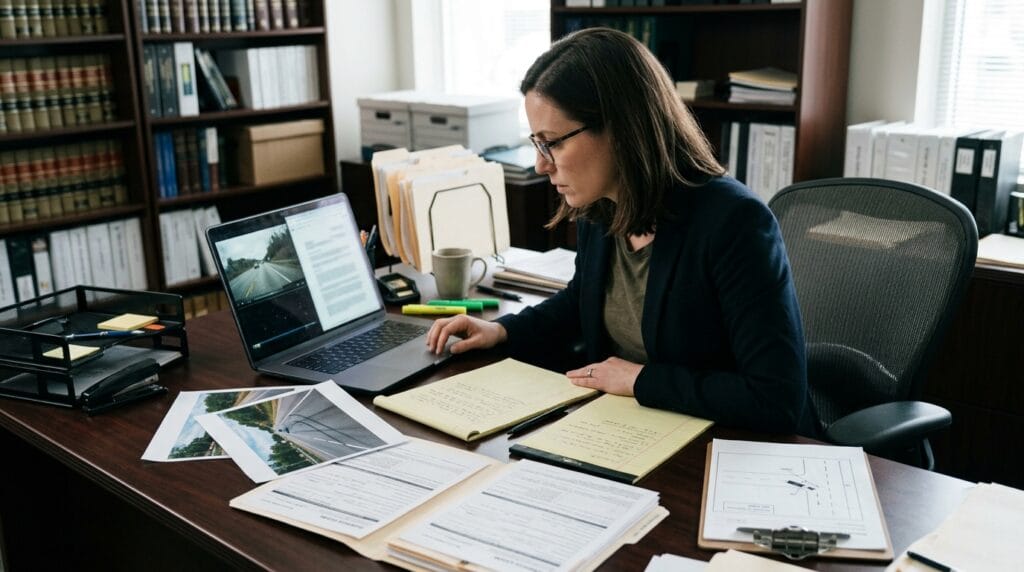
Photographs should show the stopped vehicle, nearby lanes, warning equipment, road shoulder, traffic signs, and any visible damage.
Witnesses may remember whether the approaching driver changed lanes, slowed down, or appeared distracted. Their contact details can become valuable if the parties later disagree about the accident.
Dashcam footage may provide a clearer timeline. Video can reveal when warning lights became visible, how traffic was moving, and whether a safe alternative lane appeared available.
Some vehicles also record electronic information about braking, speed, and other events. The availability and accessibility of this information vary.
Preserving evidence quickly matters because nearby businesses may overwrite surveillance recordings, vehicles may be repaired, and damaged roadway equipment may be removed.
Medical documentation and insurance coverage are equally important
Proving fault is only one part of a personal injury claim. Medical documentation helps establish what injuries occurred, the treatment required, and how the collision affected daily life.
Relevant records can include emergency treatment, diagnostic imaging, surgical reports, rehabilitation notes, prescriptions, and documented work restrictions.
California’s minimum automobile liability requirements increased in January 2025 to $30,000 for injury or death of one person, $60,000 for injury or death of multiple people in one accident, and $15,000 for property damage.
These minimum amounts remain relevant in 2026, although serious roadside injuries may generate losses exceeding the responsible driver’s available policy limits.
Additional coverage may require investigation. Depending on the facts, commercial insurance, employer liability, uninsured motorist protection, or other policies may become relevant.
Insurance availability and legal responsibility are separate questions. A defendant may be liable for damages even when available insurance is insufficient to pay the entire amount.
Our article on wrong-way crashes in Orange County provides additional background on catastrophic injuries, accident reconstruction, and disputed insurance claims.
Victims should also document lost earnings and other financial consequences. Pay records, employer correspondence, transportation expenses, and treatment receipts may help establish economic damages.
Non-economic damages, including pain and suffering, may also be recoverable in qualifying cases. Their evaluation depends on medical evidence, the extent of the injury, applicable law, and other circumstances.
California Code of Civil Procedure Section 335.1 generally establishes a two-year filing period for many personal injury lawsuits. Different deadlines or exceptions may apply, especially when public entities are involved.
People considering a claim should not assume they can safely wait until the final months of that period. Evidence may become unavailable long before a legal deadline expires.
To reduce roadside risk, motorists should remain attentive to vehicles stopped along the highway. When approaching warning lights or cones, evaluate traffic early and move away from the adjacent lane when safe and legally permitted.
If changing lanes is unsafe, slow to a prudent speed. Never make a sudden maneuver that creates a new hazard for nearby vehicles.
Drivers experiencing mechanical trouble should seek a safe stopping location when possible, activate appropriate warnings, and avoid standing in exposed traffic areas.
Passengers should follow emergency personnel’s instructions and remain away from moving traffic whenever possible.
The expanded California Move Over law reflects an important principle: roadside safety protects ordinary motorists as well as emergency workers.
For Orange County residents, understanding the 2026 rules may help prevent avoidable collisions and clarify important questions after an injury.
A roadside accident claim should consider driver attention, warning devices, available lanes, vehicle position, accident evidence, medical consequences, and applicable insurance.
Disclaimer: This article provides general educational information and is not legal advice. Each accident requires an individual assessment under applicable California law.